Coatings & Thinners
Solvent for nitrocellulose, acrylic, vinyl and polyurethane coating systems; balances dry time against blushing in the finished film.




CAS 141-78-6 · Assay ≥99.5% · 200 L drums to ISO tanks
Producer-origin ethyl acetate for coatings, inks, adhesives and pharmaceutical processing — supplied by Ascent Group Co., Ltd with a batch COA per lot.
Company
A chemical supply company built around one solvent done properly.
Ascent Group Co., Ltd supplies INEOS Ethyl Acetate (CAS 141-78-6) to formulators and converters who cannot afford a difference between the sample they approved and the drum they receive. Our material originates from INEOS Oxide acetate ester production, where ethyl acetate is released against a defined specification envelope; our work is to protect that envelope from the plant gate to your tank.
We keep the commercial side simple: fixed pack sizes, published assay and water limits, batch traceability, and a named contact who answers technical questions from data instead of forwarding them. Buyers in coatings, flexible packaging, adhesives and pharmaceutical intermediates use Ascent Group as a documented single source for ethyl acetate and the related acetate esters they run alongside it.

Product
Three release specifications, one chemistry.
Ethyl acetate is a single-molecule ester, CH3COOC2H5, molecular weight 88.11. Grade selection is therefore not about a different substance but about how tightly water, acidity and colour are held at release. INEOS Oxide issues the material under three commercial designations, and Ascent Group supplies each against the matching certificate.
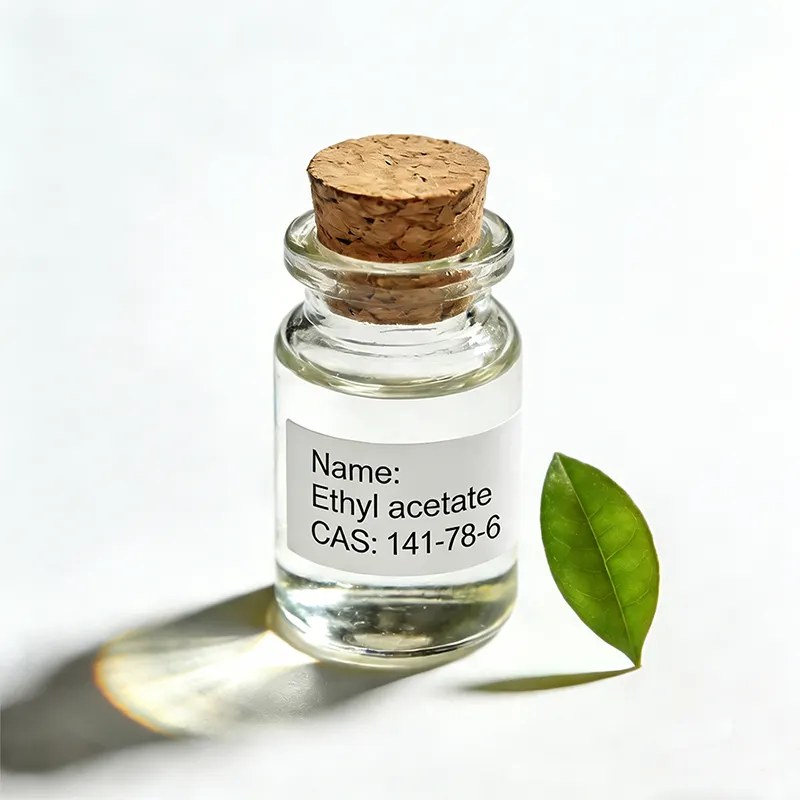
General-purpose release at 99.5% minimum assay with water at or below 0.10%. Chosen for let-down and thinning where the formulation is not moisture-critical: nitrocellulose lacquers, general industrial coatings, cleaning blends and extraction steps.
Tightened water and acidity limits for two-component polyurethane and moisture-sensitive isocyanate systems. In these formulations one molecule of water consumes roughly two isocyanate groups, forming urea and carbon dioxide — visible as haze, bubbles or film defects.
Released for kosher-certified manufacturing environments, typically pharmaceutical, food-contact and personal-care processes where the certifying body requires a kosher declaration on the solvent.
Grade availability and release limits are confirmed on the certificate of analysis for each lot.
Specifications
Values follow the INEOS technical datasheet for ethyl acetate.
| Property | Value |
|---|---|
| CAS number | 141-78-6 |
| Formula / molecular weight | C4H8O2 / 88.11 g/mol |
| Appearance | Clear colourless liquid, characteristic fruity odour |
| Assay (GC) | ≥99.5% min; 99.8% quoted for INEOS standard ethyl acetate |
| Water | ≤0.10% max (technical grade; lower for urethane grade) |
| Acidity as acetic acid | ≤0.01% max (technical grade) |
| Colour (Pt-Co / APHA) | ≤10 |
| Density at 20 °C | 0.9008 g/cm³ (approx. 1110 L per tonne) |
| Boiling point at 101.3 kPa | 76.5 °C |
| Freezing point | approx. −83.6 °C |
| Flash point (Abel closed cup) | −3 °C |
| Auto-ignition temperature | 426 °C |
| Explosive limits in air | 2.2 – 11.5 vol% |
| Vapour pressure at 20 °C | 96.9 mbar |
| Viscosity at 20 °C | 0.46 mPa·s |
| Refractive index nD20 | 1.373 |
| Evaporation rate (n-butyl acetate = 1) | 4.2 |
| Water solubility at 20 °C | approx. 80 g/L; miscible with common organic solvents |
| Hansen parameters | δd 15.8 · δp 5.3 · δh 7.2 MPa½ |
| Volume resistivity | 1.1 × 10⁷ Ω·m |
| Storage stability | approx. 2 years under recommended storage conditions |

Applications
A fast, clean-evaporating ester solvent that carries a formulation without leaving a trace of itself.

Solvent for nitrocellulose, acrylic, vinyl and polyurethane coating systems; balances dry time against blushing in the finished film.
Dissolves gravure and flexographic ink vehicles for flexible packaging, where controlled evaporation gives clean, low-residue print.
Carrier for solvent-borne and laminating adhesive systems, including food-packaging lamination where odour and residue limits are tight.
Process solvent for extraction, crystallisation and purification steps, chosen where a lower-toxicity ester solvent is preferred.
The volatile carrier in nail enamels and enamel removers, where fast, even evaporation defines the user experience.
Non-halogenated, fast-drying solvent for electronic components, optical parts and general precision cleaning.
Supply Advantages
The specification is the product. Everything else is logistics.

Sourced from INEOS Oxide acetate ester production rather than blended or re-packaged stock, so the assay on the drum matches the assay on the certificate.
Sealed closures, dry nitrogen blanket on bulk parcels, and immediate resealing after sampling, because water pickup is the first thing that moves acidity.
Lot number, release date and test results travel with the shipment; every question is answered against a specific batch.
From a single drum for qualification runs to ISO-tank and bulk parcels for continuous lines.
SDS, COA and export paperwork issued with the shipment.
Kristy Chen handles enquiry, quotation and after-sales for your account from first message onward.

Quality
Documented, not asserted.
Ethyl acetate at origin is produced under accredited ISO 9001 and ISO 14001 management systems, with laboratory information management supporting in-process testing and process control on the line. Acetate esters also pick up contamination from shared shipping space, so cargo segregation and prior-cargo control matter as much as the plant specification. Ascent Group releases this product only into parcels whose previous cargo is known and compatible, and hands over the release documentation for every lot.
Packaging
Sealed, dry and documented from the filling line to your store.
Sealed single-trip drum for qualification runs and small-volume production.
Approx. net weight 180 kgComposite IBC for mid-volume production; forklift handling with resealable top fitting.
Capacity 1000 LFor continuous production, delivered with documentation and, where agreed, a dry nitrogen blanket.
Approx. load 20–24 tContracted volume delivered to your tank farm; earthing and bonding at the receiving point.
Volume Per contract
Lead time is confirmed at quotation; scheduled call-offs are available for repeat volume.
Incoterms agreed per order (EXW / FOB / CFR / CIF), with packing list and net weights issued alongside the shipping documents.
On arrival: keep closures sealed, exclude humid air, rotate stock, and store away from ignition risk — the product is stable for around two years under recommended conditions.
FAQ
Five questions buyers ask before the first order.
Technical grade is held at 99.5% minimum assay with water at or below 0.10%. Urethane grade tightens water and acidity, because in two-component polyurethane one molecule of water consumes roughly two isocyanate groups. If your system is moisture-sensitive, specify urethane grade.
Closures stay sealed until first use, bulk parcels travel under a dry nitrogen blanket where agreed, and drums are resealed immediately after sampling. Ethyl acetate hydrolyses slowly in water and the first sign is rising acidity, so both are verified against the certificate on arrival.
A batch certificate of analysis covering assay, water, acidity, colour and non-volatile matter; a GHS/CLP safety data sheet; a packing list with net weights; and the origin paperwork your market requires.
Yes. Drum quantities are the usual route for qualification and stability trials, drawn from the same release specification as the bulk parcel that follows. Tell us the limits you must hold and the quotation will be written against them.
UN 1173, Class 3 flammable liquid, packing group II, flash point about −3 °C by Abel closed cup, explosive limits roughly 2.2 to 11.5 volume percent in air. Storage must be bunded, ventilated and free of ignition sources, with bonding and earthing during transfer.
Insights
Technical, practical and commercial notes for buyers of acetate ester solvents.
 Technical
Why a 0.02% water level can separate a clear urethane film from a hazy one, and how rising acidity cuts nitrocellulose viscosity during storage.
 Knowledge
A practical way to read a specification envelope against your formulation, from let-down lacquers to isocyanate-crosslinked systems.
 Commercial
Feedstock, energy, freight and regional supply length — and why landed cost on an identical specification is the only meaningful comparison.
Contact
Tell us the grade, the pack size and the specification limits you must hold. Kristy Chen will reply with a quotation written against those limits, the current release data for the grade, and an indicative lead time.

Kristy Chen
Scan to add Kristy Chen on WhatsApp
 +8618018036652
 sales6@ascent-chem.com
 +8618018036652
 Kristy Chen
 Scan to WhatsApp